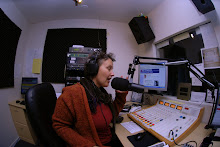
Today at Tomorrow Matters, so much was discussed! We had over ten callers and a lot of enthusiasm about seeds, staph infection, and Obama.
Here are some web resources that were mentioned:
Reneesgarden.com
thepickensplan.com
MIT solar panels
Green tip:
Put pure silicone tablets in your seed containers to store them without moisture risks.
Have a happy Monday!
Olana & Deborah
Monday, July 14, 2008


Friday, July 11, 2008
Peak Moment
Janaia Donaldson from Peak Moment TV was with us today. Locally, Peak Moment TV plays on channel 24 on AMP television. The episodes address "perspectives and initiatives for local self-reliant living in the face of energy, climate, and economic uncertainty."
In the studio today, Janaia and Deborah switched places, giving Deborah a chance to share why she is passionate about Tomorrow Matters. As a mother of two, it is important that she does all that she can and will never have to answer the question of, "Why didn't you do anything, Mom? You didn't do everything you could to make a difference?" Deborah shared some incredible exercises with us that help children understand the intensity of our fossil fuel dependence. My favorite is the lesson plan in which you chart a story of where a can of chicken soup comes from, followed by a discussion about the energy used in the process. I wish we all had the chance to experience these types of lessons as young children.
Thank you Janaia for speaking today! Please visit Peak Moment for more info.
Thursday, July 10, 2008
The Future of Food Matters
Escondido Farmer and sustainable farming consultant, Scott Murray was with us today. Murray Farms and the San Pasqual Academy reap the benefits of his labor. At San Pasqual Academy, the students live on campus, and their campus is a farm. Murray teaches vocational and food-literacy. Fed from the 20 acres of vegetable gardens, these students are being educated in a way to help avoid the U.S. obesity epidemic. Murray informed us today that they are making progress, and the students are becoming inspired throughout the process of growing things such as five different colors of carrots.
We love the idea of food literacy! Teaching school age children how to eat balanced, organic meals is paramount, and it is wonderful that San Pasquale Academy is doing just that. Right on! Murray also pointed out that we cannot assume that everyone knows where their food is coming from.
Organic farming is experiencing its share of challenges as well. On the top of the list is oil prices. Increasing fuel costs means higher food cost. So what can we do? Shop at the farmers market of course; and while you're there, take Scott Murray's advice and give your local farmer a big hug.
Slow Food Nation is coming up at the end of August. Murray recommends this event to learn about a wonderful alternative to fast food. To contact Scott, email him at ScottAMurray@SBCglobal.net.
Thank you all for listening!
Olana and Deborah
Wednesday, July 9, 2008
Engage in the Change
Our guest today, Frances Moore Lappe, author of sixteen books including Diet For a Small Planet, spoke with us today about the ideas behind her latest, titled: Getting a Grip.
Frances believes that ideas are more powerful than instinct. In general, we are seeing the world through a frame of scarcity, but in reality there is a world of possibility in front of us. Getting a Grip refers to the social order which is defining our system. Our current self-defeating system can be shifted once we all quit blaming- and start taking responsibility for changing a system which produces backwards politicians and injustice.
Her idea of "living democracy," helps relieve our ingrained assumptions of who has power. In reality we all hold the power! Every choice we make, from shopping, to fueling, to dumping, is in fact changing the world. It's up to us whether our impact is positive or negative.
One inspirational reality that Frances shared with us is the Apprentice Citizenship program in Vermont. These K-12 classes take responsibility for teaching our children how to operate within a living democracy, through mediation and negotiation training.
Also inspiring was the story Frances shared with us about a friend who was elected as a city official, despite her initial skepticism. Many of us worry that a lack of finances will prevent us from running, and if this is a worry that woes you, visit Just Six Dollars.
Let's take Frances Moore Lappe's advice and get a grip on climate change. We know what to do, and doing so is not a burden. Living your life with intention through every act feels so good! (and comes highly recommended by us at Tomorrow Matters!)
To contact Frances Moore Lappe, or to learn more information, visit her websites Small Planet, and/or Take a Bite.
As always thanks so much for listening!
Olana and Deborah
Tuesday, July 8, 2008
The Fruit of the Funghi
Today, Mia Rose Maltz, the Co-founder of the Rites Project spoke with us. Mia has been studying mycology, mushroom cultivation and mycorestoration for over ten years. For more information you can contact her at theritesproject@yahoo.com. She will also be holding a Solar Living workshop on August 24, 2008.
Maltz explained the importance of mycelium webs due to there decomposing capabilities. Contaminants such as petroleum will be treated like a food source by the mycelium, which will then produce the necessary digestive enzymes to break the contaminant down. Sooner than later, oil laden soil will have mushrooms, grasses, and insects again. It can replenish and renew with the help of the mycelium, becoming an oasis of life.
Maltz also recommended some great books for the identification of your various fungi. Mushrooms Demystified and All the Rain Promises and More, both my David Aurora will help solve your mushroom mystery. Maltz suggests viewing Paul Stamets website, Fungi Perfecti a family-owned, environmentally friendly company specializing in using gourmet and medicinal mushrooms to improve the health of the planet and its people.
We'd like to thank Mia Rose Maltz for being on the show today. Thanks to our listeners as well!
Olana & Deborah
Monday, July 7, 2008
Peak Oil
Jim Baldauf and Steve Andrews from ASPO-USA joined us today to discuss and educate the public about our global energy supply. Peak oil is the peak of the oils production within a nation. In the U.S. this finite resource took peak in 1970, and began an eventual decline ever since. Peak oil doesn't mean that we are out of oil. It's more of an indication that we are at a halfway point, and should begin saving oil for things that require oil, things that only oil can do.
ASPO-USA assures us that the general trend line for oil prices will continue to be higher. And substitutions from conventional oil will always cost more. With 86 million barrels of petroleum liquids used per day, what can we do to help ourselves through this reliance on inexpensive fossil fuels? Today we are consuming three barrels for every one barrel discovered. Even with smarter drilling techniques, offshore drilling is considered a bad idea by Baldauf and Andrews. It is very expensive, and uncertain because of difficulties predicting how much oil is down there. In the future ASPO-USA say we need to think about efficiency first and foremost.
One great question asked today was, Do we have the time to shift our systems of transportation before it's too late? See The Hirsch Report for further information about our energy uncertainties.
Visit the ASPO-USA conference this September in Sacramento to learn more.
Thank You,
Olana & Deborah
Thursday, July 3, 2008
Tending the Wild
Permaculture guru, Benjamin Fahrer was our guest today. He briefly spoke about his evacuation process from the Big Sur fire. Discussed was the possibility of managing fires with fire breaks, smaller fires throughout the year, and plants that can actually help with fires. Fahrer seems optimistic that our nature system will prevail, yet recommends policy changes which will address managing fires differently; by working with them rather than against them. Interesting. If you want to hear more of Fahrer's ideas check out Wise Earth and drop him an email. He highly recommends the book, Tending to the Wild, by Pat Anderson.
We want to give our deepest thanks to the fire fighters and community members who are helping with the Big Sur fire. Please look at Sur Fire 2008 to offer to volunteer, or to find a volunteer, housing or news on the fire.
Thank you to our callers for sharing your stories today. We picked up a great post-fire tip from Jeff, who worked with the Marble Cone Fire in 1977. Apparently burned soil is a great place to scatter seeded Winter rye. It absolutely flourishes!
Thank you for listening, and have a happy, fire-works free 4th Of July. Lets not start any more fires.
Olana and Deborah
Subscribe to:
Posts (Atom)