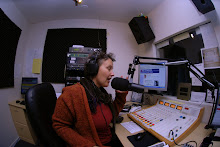
Thank you so much for joining us today, Rebekah and Steven Hren, authors of Carbon Free Home. The Hren's are on a book tour promoting their innovative collection of remodeling projects, aimed at reducing our reliance on fossil fuels. The thirty-six projects are written for a variety of skill levels, and can be integrated into newer building designs as well as renovations.
The Hren's shared a couple renter-friendly projects:
1. Turn down your hot water heaters! Typically they are set around 140 degrees, but will function effectively at 120 degrees.
2. Stevens favorite project is to build a solar oven, which takes further advantage of the California sunshine (if you're local.) Cooking your food with the sun is a beautiful thing!
3. Rebekah enjoys the refrigerator installation project. Insulating your fridge on the outside, with cork, carpet, or a variety of used materials, reduced the fridge's energy use by 20% to 30%. Wow!
For fellow composters: One favorite project for the home owner is to install a bio-digester system which creates and captures methane energy as it's produced, throughout the decomposing process. Check out Carbon Free Home for more info.
The Hren's believe that it is always best to use what you have before investing in something new. This is the "greenest" approach you can take. It is important to get the most out of what we have first and foremost. Tearing down an old home to build a "green" home maybe isn't that "green" after all, eh? What do you think?
One suggestion that we found exciting at Tomorrow Matters is the energy diary. The Hren's suggest keeping a diary as a way to track your home's energy use, to see where it is really going. They have discovered that a lot of energy is used for "phantom loads," or items plugged in while not in use, yet still sucking power.
Carbon Free Home is written in a do-it-yourself style, which cuts the costs of hiring help. Encouraged throughout the book is dumpster diving for materials, or finding used ones through trading or on your street corner We are lucky to have the Last Chance Mercantile at our local waste management center. Rebekah and Steven recommend trying to see the value in what is being thrown away.
In the future the Hren's hope to explore alternative transportation further, through electric biking, and other fossil fuel alternatives. To catch them on their book tour see the Carbon Free website.
Thank you for listening! Feel free to comment with any home improvements that you plan to try, or would like to suggest... to reduce our carbon footprint.
Olana and Deborah
Wednesday, July 2, 2008


Tuesday, July 1, 2008
The 11th Hour
Our guest today, Mr. Stephen McGuire, associate producer of The 11th Hour, joined us from Tree Media Group to discuss the film and campaign. The title, The 11th Hour is inspired by the feeling that NOW is our last moment to change or correct our course before global collapse. Tree Media Group and Leonardo DeCaprio's film addresses global issues and their solutions by reaching out to fifty experts throughout the documentary. The discussion on the state of the world and the state of humanity, is now available on DVD. What is it we are doing? Why aren't we changing? In the 11th hour, questions such as these are addressed.
The most wonderful thing about The 11th Hour is that there are solutions! The film is not just another outcry, it is a solution based wake up call created by great minds joined together to spread awareness.
Stephen tells us that Leonardo is intelligent and full of integrity. He is a personal fan of Woody Harrelson's website, Voice Yourself, which includes heaps of green initiatives and encourages community involvement. For more info on Leo DeCaprio's involvement visit his website here.
The 11th Hour team at Tree Media's Campus Tours have been touring U.S. campuses to show the film and spread awareness. Locally they have visited UC Santa Cruz. The campaign's purpose is to share experiences, solutions, and spread awareness of the films insights.
We thank Stephen McGuire for joining us on the show today, and for providing three DVD's for our give away. Thanks, also, to our callers for sharing your green tips with us on air. We hope you enjoy The 11th Hour as much as we did!
Please log on to The 11th Hour Action Campaign to begin taking action now!
Olana and Deborah
Monday, June 30, 2008
Building Like a Tree
Our guest today, Eric Corey Freed, sculpts innovative buildings that embody ecological and social responsibility. Architect, author, and educator Freed can be contacted through his website http://www.organicarchitect.com.
Our show was salted with a variety of topics and ideas! Freed mentioned five most important questions to consider when designing a building.
1. Where does the material come from?
2. What are the by-products as these materials are manufactured?
3. How are the materials delivered and installed?
4. How toxic are these materials?
5. What are we going to do with these materials when we're done with them?
No building system or material will get an A+ in sustainability in all categories. Take one material like bamboo, for example. As incredibly renewable as it is, bamboo still travels all the way from China to the U.S., which increases the carbon footprint.
Eric Freed will be speaking at The West Coast Green conference September 25th-27th. He plans to advise listeners of his "Extremely Unusual Look at Green Building."
Freed told us: If a standard escalator was put on a sensor to start running once someone steps on, and stop when no one is riding, an estimated savings of $6,500 per year and 75% of its total energy use would accumulate. Freed is driven to design buildings that give back. His idea of the zero energy home is a concept in which each home breaks even in its energy use in production, if not producing more energy that it uses. One favorite tip is the idea of the green roof. Planting on roof tops absorbs carbon, produces oxygen, and acts as insulation.
In an average persons home there are some simple changes we can make:
1. Change light bulbs to compact fluorescent.
2. Purchase a programmable thermostat.
3. Place (full) 2 liter water bottles in your toilet tank to displace the same amount of water with every flush.
4. Invest in double pane windows.
5. Our favorite tip involves grey water redistribution with the help of the handy Aqus system, found at watersavertech.com
The older system of building is extremely inefficient, but Freed conceives his designs as if they were inspired by nature. His idea of building like a tree treats the structure of the design like an ornament, with all parts relating to the whole. One of the greater ways to build today, is with SIP or Structural Insulated Panel. Visit West Coast Green to learn more and see a demonstration.
Visit Urban Revision.com to participate in a creative competition making a poster with your vision of the year 2050.
That's it for today!
Happy Monday,
Olana and Deborah
Friday, June 27, 2008
Live Like You Love the Ocean
Guest speaker J.Nichols from the Ocean Conservancy visited the show today. He reminds us that the ocean can't take it all, like many used to think. Rivers containing runoff from cities, agriculture and the entire world end up in our oceans can cause dead zones, which are repairable once we discontinue poisoning our our waters. The life and diversity of our world's oceans will replenish!
There are three issues we can look at concerning the health of ocean-life.
1. There is too much going in: oil pollutants, mercury and other contaminants.
2. There is too much coming out due to overfishing, and by-catch.
3. Damage in the coastal areas though development, habitat destruction, etc.
In response...We need to implement policies to help protect our oceans!!!
Nichols points out the importance of current Act "Oceans 21," which is legislation concerned with treating the ocean with the care it deserves.
Nichols started a Sea Turtle program called SEE Turtles found at www.seeturtles.org People can sign up to take sea turtle tours in areas where visitors do not harm the turtle habitats, meanwhile helping the coastal communities in which theses beautiful creatures are found. Eco tourism destinations include Baja, Trinidad, and Costa Rica.
In Monterey County Leatherhead Turtles are found. How we fish, what we do with our waste, and what we eat are all factors which determine the health of these turtles. Plastic bags floating in the ocean are easily mistaken for algae and will be consumed by turtles.
Although sustainable seafood can be confusing, one thing is pretty certain. Shrimp require nets sweeping over the ocean floor, killing everything in its path in order to catch this favored commodity. If you simply cannot give it up, PLEASE find sustainable shrimp! Take at look at www.Shrimpsuck.org for more information.
Have a great weekend, and thanks for listening! Feel free to comment.
Olana and Deborah
Tuesday, June 17, 2008
Fake plastic fish... is that what wil be left?
Beth Terry, an anti-plastic activist guru from FakePlasticFish.com. Visit this site to find so many resources on how to avoid plastics in your life.
Here are some websites she recommended:
Green Sangha - an environmental spiritual community
Algalita Marine Research Foundation - to find out more on plastics in the ocean.
Take Back the Filter - a citizens action to get Clorox to recycle the Brita Filters.
Eco Dent - eco groovy dental floss.
Perserve Toothbrush - a recycled plastic toothbrush.
Burtz Bees shampoo and conditioner bars for no plastic container hair care.
To go Ware - helping us get away from disposable food service items. But I think we can just go to a yard sale and buy some dishware there.
The following table is only approximate as we can not verify plastic biodegrading in 800 years because it hasn't been around that long...please keep this in mind...
The biodegradable time table.
* Banana peel, 2 – 10 days
* Cotton rags, 1 – 5 months
* Biodegradable plastic bags, 75 days
* Sugarcane Pulp Products, 30 - 60 days
* Paper, 2 – 5 months
* Rope, 3 – 14 months
* Orange peels, 6 months
* Wool socks, 1 – 5 years
* Cigarette filters, 1 – 12 years
* Tetrapaks (plastic composite milk cartons), 5 years
* Plastic bags, 10 – 20 years
* Leather shoes, 25 – 40 years
* Nylon fabric, 30 – 40 years
* Plastic six-pack holder rings, 450 years
* Diapers and sanitary napkins 500 – 800 years
* Tin cans 50 - 100 years
* Aluminum cans 80 - 100 years
* Plastic Bottles non-biodegradeable
* Styrofoam cup, non-biodegradeable
Note... the following is a reprint from the US Department of Energy...talking about the biodegradability of plastic....
"This depends upon the plastic (polymer) and the environment to which it is
exposed. Polystyrene decomposes quickly when exposed to sun and weather, as
do polyvinyl acetates, other polyesters, and polyvinylchloride. On the other
hand, polyvinylfluoride (DuPont's Teflon (TM)) is virtually indestructable. Even the same polymer can differ quite widely in its decomposition depending upon how it
is formulated."
So, the list above that says a styrofoam cup is non-biodegradable may not be correct... but there's also the question of whether it actually goes "away" or simply gets very very small and the particles themselves are still present in nature... and toxic.
That's it for today!
d
Monday, June 16, 2008
Climate Solutions
The thing to say about todays' show is simply.. Get The Book!! Climate Solutions, a Citizens Guide, What woks, What doesn't and Why" by Peter Barnes, published by Chelsea Green Press.
It's a fantastic, easy to read book about the solutions to climate change.... find answers to cap and trade, and carbon taxes, and all the jargon we hear on the news.. but hear it in a way that makes sense, including the pros and cons and better alternatives.
So, there... just read it!
Some suggestions from Peter today...
1. He recommended we look at climate solutions as a policy problem and we need to put pressure on our elected officials to change the policies around carbon emissions. In California write these two senators and tell them to pass "zero emissions" by 2050 Boxer and Feinstein...
2. We can join 1sky.org to support their work and join their email network.
3. Also join wecansolveit.org, Al Gores climate change site.
4. Check out Peters site, Cap and Dividend.org that outlines ways to stop CO2 emissions using market-based solutions, without reducing household incomes.
We need to reduce Co2 emissions ASAP.. can we do it?
Deb
Thursday, June 12, 2008
Eco Cities - Redesigning for the Future
Michael Gosney of Green Century Institute came on the show today to discuss how we redesign and rebuild our human settlements and integrate natural systems to lower the CO2 emissions of the places we live.
Michael had plenty of resources to share... here's a list.
Wiser Earth is an online tool for collaboration on projects, and is the brain child of Paul Hawken, author of Blessed Unrest.
Also check out Visible Strategies and Sustainability Dashboards as tools to help build eco cities.
For your home use go to GreenHome.com to find products that lower your energy use and walk softer on the planet.
Check out Ecovillage.org for a network of community villages.
and BuildGreen.com for suppliers of green materials and builders of alternative structures.
Arcosanti is currently the best model for a sustainable city.
Personally, I think we need to start creating our own eco cities just in the places we live and one of the best ways to do it is to take back the streets on which we live. Not major roads, but the small side streets that don't have a ton of traffic... take it back. Like the days when kids played hockey on the streets.. get out there, put up a barrier and play Frisbee or have a BBQ with your neighbors. The revolution starts just outside our front door! Really!
Deb
Subscribe to:
Posts (Atom)